WYRE FARM CAMP SCHOOL - THE WAR YEARS.
Researched by Trev Teasdel
You can download this article as a PDF file.
Following on from The National Camps Corporation article, I want to take you back, through the eyes of some of those that were there, to the war years. I have brought together all that we know of the war years, information scattered in various posts and cuttings on the school blog. Wyre Farm Camp School was built towards the end of 1939, prior to the declaration of the 2nd World War.
Lionel John Aubrey puts the situation in perspective.
OPERATION MOONLIGHT SONATA
" In October 1940 there were short periods of intense bombing on the City of Coventry, followed by the blitz of November 14 ~ 16 ~ OPERATION MOONLIGHT SONATA. Over this 2 day period 500 tons of high explosives were dropped on the city and the city centre was ablaze. The city’s factories were blasted and burning and when the all clear sounded at 6.15 am of the third day, the shocked, dazed, frightened and tired people of Coventry emerged into what had once been streets, to find 4,330 homes had been destroyed and over 1200 people had been killed. There were further bombing raids with 6/8 hour intense periods on the 8th and 10th April 1941 and the last bombing raid was in August 1942."

From The Coventry Telegraph 1983 " The summer of 1940 was rife with rumours of an invasion. There was one, however, which was peaceful and unopposed. This was when 200, 12 year old Coventry boys descended upon Shropshire. They had been evacuated because of the worsening situation in France.
On arrival at the camp on Monday June 17th 1940, there was a brief ceremony led by the Rev Richard Lee and the Union Flag was raised. After dinner the lads were distributed to the four dormitory huts which were Gosford, Radford, Earlsdon and Stoke."

Dennis Whiteley, (Secretary of the Old Boys Association), takes us through those early moments in an article written for the Coventry Telegraph, by Peter Walters. Actual article below.
THE PIONEERS ARRIVE AND IT'S HANDS ON TO SET UP THE CAMP.
"As a convoy of battered buses pulled up at the camp gates, some 200 Coventry kids got their first eyeful of the timber huts that were to be their home from home. Dennis Whiteley, just 14 at the time can still remember the air of mounting excitement as they piled out of the vehicles and formed up in ranks to march the final few yards.
The date was 17th of June 1940 and the 200 were pioneers - the first batch of Coventry evacuees to reach the safety of Wyre Farm Camp School, in a quiet corner of south Shropshire.
With the Luftwaffe's attack on Britain already underway, Coventry was looking like an increasingly dangerous place for children in the summer of 1940. To the city's education authorities, the rural location seemed a safer bet.
For Dennis Whiteley and his pals from a string of city schools, it was the start of a great adventure that he still recalls fondly more than 50 years later.
"We were put to work clearing fields for Football and cricket pitches, and I remember forays into the forest to cut wood for goal posts, under the supervision of Mr Griffiths."
During the hard winter of 1940 the boys had to manhandle sledges over snow drifts to pick up the bread from the railway station. Even in the harshest of weathers, they were found running around in plimsolls and shorts. The evacuees devised an initiation ceremony for newcomers that involved crossing a river ford in the middle of winter stark naked!
However Dennis does recall homesickness, Not all boys were happy, he does recall a few sobs after lights out on the first night. "Most of us loved it but there were one or two who decided to run. The furthest anyone got was Kidderminster. The local bobbies on their bikes used to pick them up on the roads." He does recall his younger brother Jim who walked all the way back to Coventry only to be brought back by his parents. The punishment for boys running away was being called up in front of the whole school at assembly and being canned.
It wasn't long before evacuees became familiar in Cleobury Mortimer, marching through he village on Sunday on church parade and crowding into the village shop to buy cakes and pop. Relations with the locals were good on the whole. More than one Coventry kid ended up returning to marry a village girl.
Dennis remembers when a Spitfire roared low over the camp and dropped a small parcel and performed a low level loop the loop. It was the camp cook's fighter pilot son delivering her birthday present.
Dennis said "there were 8 teachers and the camp was a collection of wooden buildings, providing dormitories and bunks, classrooms and an assembly hall. He remembered swimming in the river, battling through deep snow, and scrumping apples, picking blackberries for the camp cook and playing schools at football. To us the countryside was unknown, Shropshire was very rural at that time and we had all come from the city to be surrounded by miles and miles of countryside. We had never seen anything like it."
They had only been there about 6 months when on the night of November 14th 1940 they saw the flames of Coventry burning on the night of the Coventry blitz.

SCHOOL BUILDINGS
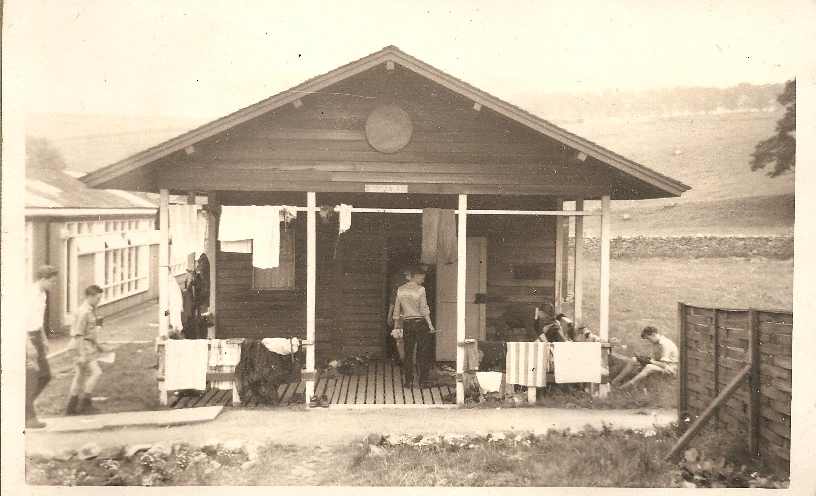
The school back then would have been recognisable, but there were more houses - with some dorms having more than one house in it. The houses were named after areas of Coventry until the mid 50's, such as Bablake, Stoke, Radford, Gosford, Godiva, Mercia and Earlsdon and all the dorms had verandas on the end - the flats came later. No swimming pool; and no garages or small classroom such as Mr Lovett's.

Bert Gummery "“We were all put into houses named after districts in Coventry – I was in Earlsdon house – and we slept in house dormitories in bunk beds. We had lessons each day and played a lot of sports and games, especially football and cricket. I can remember us marching down to the village to church and also going to a cinema in the village. It was strict; you had to behave yourself just like at ordinary school, but we enjoyed it and mother used to visit every month from Coventry.”
Lionel John Aubrey "You represented your ‘house’ in all aspects of life, collecting points from promptness, cleanliness, attendance, sport etc. Each house had a master and 2 prefects."
Bert Gummery ""I was one of the first intake of evacuees there. I remember arriving at the school clutching a jar of jam – we were all allowed to take a jar of home-made jam with us with our name on which were able to have at meal times. I also recall a photographer taking our picture."
The Daily Telegraph Tuesday June the 9th 1942 Coventry Boys are Learning in a Children's Paradise.
"Five dormitories with 170 lads...two tier beds and every pupil is equipped with a separate locker for their personal belongings. A large dining room complete with modern kitchens and a spacious assembly hall and chalet like home for the headmaster Mr B Martin. The school contains a gymnasium, library, woodwork and art room."

HEADMASTERS AND TEACHING STAFF
The first headmaster was Mr Donaldson, known for his use of the cane and he set the bar for the school discipline which continued to be followed after his departure. Mr Donaldson was only there until 1942, it was a two year contract..

Coventry Evening Telegraph memories by Stan Atkins 1983 "Mr Donaldson was from Broadway school in Earlsdon. To keep his charges in order he had the assistance of masters drawn from Coventry schools.He was also previously head of Twon Thorns Camp school at Easenhall Coventry.
Mr Donaldson is typical of the period, strict but fair. On one occasion, after a pitched battle between the dormitories, he dispensed summary justice by lining the school up and caning every 10th boy.
No one complained except perhaps the unfortunate "tenth boys"
At first the lads were viewed with suspicion by the locals but they soon got used to the invaders. In an area with many apple orchards, there was scrumping. The farmers, like Mr Donaldson, dispensed their own justice. A clip round the ear was usually sufficient,. The odd serious misbehaviour was dealt with very severely by Mr Donaldson.
From the cutting in the Midland Daily Telegraph August 1940 we get a portrait of Mrs Donaldson - the headmaster's wife -
" A word about the one person who has done more than any other for the joy and comfort of the boys - Mrs Donaldson, "Mother" to every one of the boys 160 boys and wife of the Headmaster. For 16 hours a day, when the camp began and now for a full 12 hours a day, Mrs Donaldson is looking after the welfare of the lads. Youngest to oldest, if they have any troubles at all, the boys fly to her, and, in spite of the fact that she does it all without salary, she loves her job.
Mrs Donaldson waved a hand at 50 or more boys playing a variety of games. Most of them wearing nothing more than shorts and shoes, yet their sun burned bodies did not feel the coolness of the hillside wind so apparent to we city folk.
"Fresh air, good food and regular sleep did that" she said firmly "Life at the camp is equivalent to a good boarding school - and there are 40 vacancies."
His replacement was Mr B Martin (Bert) and his deputy was Mr RT Morris who eventually became the head in 1953. Mr John Lowe was another early teacher, keen on sport. Mr Lowe became deputy head under Mr Morris but left to take a headship of the newly built Willenhall Wood Junior school in Coventry c 1957.

Ken Short remembers Mr Martin "Mr. Martin liked to run a tight ship. He stayed in the background, Mr. Morris was his figurehead. Mr. Martin was unapproachable, mild mannered but still a disciplinarian. It was always Mr. Morris who seemed to organise things, one hardly saw Mr. Martin except for morning assembly. Even Sunday services at Cleobury Mortimer or Neen Savage was led by Mr. Morris, never Mr.Martin. I can never remember Mr.Martin strolling around the school, only Mr. Morris and on sports day Mr. Morris was ever present, no sign of Mr. Martin!"
Ron Brooks remembers "my dormitory was EARLSDON (E12) and MR LAMBLEY was our dorm' master and he was strict - polished our floors, beds made neat - walked on cloths on the floor to keep polished. I must admit he gave a whack on the behind with a slipper for not doing something, Ouch!"
Other teachers remembered were Mr Lambley, Mr Dey, Mr Lamb, Mr Musgrove.
However, in the Coventry Telegraph 1983, it says "The first masters were Mr Morris, Mr Windridge, Mr Breeze, Mr Carr, Mr Dey, Mr Parkes and Mr Griffiths.
LIONEL JOHN AUBREY
writing on the BBC site The War Years about Wyre Farm Camp School, tells us -
" Records show that the boys were mainly from schools in the town and factory areas of the city and by December 1942, 283 boys had been relocated to Wyre Farm. It is assumed that most of the boys had lost their homes, or parents, or both. By the end of May 1945, 584 boys had moved through Wyre Farm."

SCHOOL ITINARY
Lionel John Aubrey,
"The day usually started with a quick wash and off to the dining hut for breakfast. Prefects checked you into the hut (clean hands!) and in rotation you prepared your ‘house’ table and cleaned upon completion.
After breakfast you made you beds, cleaned and tidy the dormitory.
8.45 Assembly in the school hall, prayers, notices etc. On completion dispersed to classes. There was an opportunity here to visit Matron should you be unwell. Lessons were for set periods and you changed classrooms or teachers as required.
11.45 Lesson completed, return to dormitories to was hands etc.
12.0 Lunch, prefects supervised, on completion ~ free time.
13.0 Return by classes to classrooms
3.30 Return to dormitories, free time. There were various activities available, all supervised by prefects/Masters (Scout Group, Drama Group, Gardening, Sports)
5.0 Tea, on completion resume free time
6.30 Return to dormitories, showers, ready for bed (supervised by prefects/Masters)
8.0 Lights out
Saturdays
7.30 Breakfast. On completion carry out set tasks under supervision f prefects. E.g. clean ablutions, dining hall, classrooms. Skirmish surrounds of buildings, paint areas etc.
10.0 Various activities.
Sports team prepare. Football and cricket mainly. School team was in a league with other schools from Kidderminster, Bewdley, Stourport.
Scouts normally went camping for the weekend. Drama group was very active.
Tuck shop opened for one hour.
Sundays
9.0 After breakfast assemble in school hall for church service. If weather permitted we marched to Cleobury Mortimer Church, (approx 3 miles) prefects supervising.
After church we made our own way back to school in time for lunch. Sunday afternoon at leisure, weather permitting most of us would go for walks.
One Sunday of each month, parents/friends would visit from Coventry. Coaches (2) would come for the day, arriving about 10.30 and departing about 4pm. Lots of the boys had no parents, perhaps some of their family might come. Those of us with a parent always had one or two in our company for the day. There was always plenty of sweets and comics to share around. On occasions we would all walk in Cleobury and have a lunch, this was a real highlight. When visitors left the rest of the day was free.
(Note) lights out was early, about 8pm and of course the shutters would be applied to reduce the lights - you never knew if a bomber or two would be returning to the coast after a rain and might decided to ditch any unused bombs on the camp. You couldn't be too careful.)
FEMALE TEACHER
This is from a phone interview with Pat Bryan of Neen Savage (83 at the time) arranged for me by Aileen Parker. Pat told me she was a child during the 2nd World War. Both her Mother and her Uncle taught for a short while at Wyre Farm Camp school during the early years of the war. Pat was born in Coventry and lived off the Allesley Old Road.

Her mother , Flora Aidie who was a teacher in Coventry and her father worked in Radford. She said the outbreak of war changed their lives. Pat remembers hiding under the table in the home during the Coventry blitz not knowing if they would survive the night. Soon after the Coventry blitz November 1940 her mother was asked to go a teach at Wyre Farm Camp school where Pat's Uncle - Harold Eaves - was the Earlsdon Housemaster and teacher.
"My mother was there about a year and she was the only woman teacher. After this my mother and my dad went back to Coventry and I stayed with my uncle Harold, but then he got called up and joined the RAF, so I stayed on. I've never went back to Coventry. My maternal Grandmother had a bedsit in Cleobury Mortimer and she managed to get a cottage in Cleobury, so I moved in with her - then my father came and joined us because he was fed up with his job in Coventry, and then my mother saw an advert for a Headmistress in Neen Savage school. People said you don't want to do that - you'll end up playing the organ and singing in the choir which actually she did - anyway the woman who got the job - she only stayed a couple of months and then she took off, so the job was advertised again so that was that - she applied for the job and got it and we moved into the school house in Neen savage where there was a house with the job so we were all three of us together. The house was up the road from the church. So the first woman teacher at the school became the headmistress of Neen savage School and Pat herself studied at Bridgnorth Grammar school and her father got a job in Cleobury with Off Turns, one of the local grocers."
It wasn't until the camp became The City of Coventry Secondary Boarding School that the curriculum was set on the path towards GCE's circa 1957. Until then, the curriculum was more practical with a lot of outdoor activities such as the farm, and of course the basic subjects.
Pat doesn't recall what subjects her mother taught, but thinks it would have been Maths and English and maybe general studies. "Uncle Harold (Eaves) taught Geography and Woodwork but he got called up in 1942 along with Mr Morris and they both joined the RAF. Harold never went back to teach there.
The Midland Daily Telegraph Wednesday August 21st 1940
"The curriculum is at the moment school lessons in the morning and as much fresh air as can be obtained before bedtime at 7.30pm. Fishing, swimming, rambles, gardening, sports and games come in the latter category. Proudly the youngsters showed their vegetable plot with still the greater pride, the flock of Geese. which exist mainly on their food scraps. They pointed out with delight the six young pigs fattening in the sty. but spoke regretfully of Lilly the Lamb. Lilly strayed from the farm and found a diet of toffee cake and chocolate provided surreptitiously by the boys, better than grazing! She would persist in following the boys to their lessons and even went to sleep in the dormitory!"
The Midland Daily Telegraph Tuesday June 9th 1942
"Added to the usual school curriculum are classes in practical nature study, gardening, biology, and practical geography., the surroundings being ideal for studying the last mentioned subject. fresh air, unrestricted quantities of the best food, nightly shower baths, are but a few of the advantages of this school."
CHRISTMAS AT THE SCHOOL DURING THE WAR 1940 - Pat Bryan
"My uncle brought me back down to Coventry two or three days before Christmas because my father was still in Coventry, then he and I came back to the school on Christmas Eve 1940. We came over to stay - and my mother got us fixed up with some digs at Morley Town farm which was the farm just along from the City of Coventry School, so that was the three of us - my mother, father and myself all in one place - anyway, that was Christmas Eve. My uncle Harold - when we got to his room in the Earlsdon block where he was housemaster, we found his bed covered with Christmas socks, so we helped him put an apple and orange and some sweets into them and then crept down the dormitories putting one on each of the beds because it was Christmas Eve. The boys had to stay at the school over Christmas during the evacuation period otherwise it would have defeated the object of course. The parents sent their presents on to the school by post.
So, Christmas day came and we all ate in the big dining room and we had turkey - well I never tasted turkey in my life. In those days if you had a chicken, you had it at Christmas and Easter and special occasions, not like we do today and have it all the time and so turkey was a luxury!
The next day it snowed and the boys absolutely went berserk. They were snowballing and tobogganing.
Ron Brooks recalls visiting day
"The first Sunday of the month we would wait for the Midland Red buses to come in, I think there were four or five. The parents who couldn't come upset some of the boys, me included, although I was lucky I could go to the village as my grandmother and aunts lived there."
From The Coventry Telegraph 1983
"Although the lads were pleased to see their parents, they were often more interested in the contents of their bulging shopping bags carried by mum! Only too soon the coaches would depart and although the lads would be the last to admit it, there was many a damp eye!"
AIR RAID SHELTERS
Coventry Telegraph 1983 "Often the lads were roused from their beds and directed to the air raid shelters. Many will remember the nights when the sky in the direction of Birmingham was aflame. These were anxious days, with the disruptions to the post, news was slow to filter through. After the blitz, one enterprising dad cycled all the way to the school to tell his son he was ok! Mr Donaldson, headmaster, after the Coventry blitz, returned to City to gather what news he could and this he passed on to the assembled school."
Doug Bukin from WW2 People's War site -

" I was evacuated with about four other boys who'd been bombed out in the Coventry raid, to a place called the Wyre Farm Camp School. The camp consisted of about ten wooden dormitories, probably with about thirty or forty double bunks in them, with a hall and a refectory. It was originally built and run by the NCC (National Camps Corporation), but we named it the 'Nazi Concentration Camp'! It was said it was built for itinerant agricultural workers before the war. For a while I was miserable and homesick. I would have been quite happy to go back home to the bombs and so forth but I settled in. My parents were able to visit one Sunday a month. We all had tuck boxes, and my mother always used to bring along my favourites: rock cakes. The rock cakes lived up to their name at the end of the month when they were rock hard. And a baking dish full of rice pudding - lovely! The parents were always invited to a roast beef dinner in the refectory, which was an enjoyable and a rather rare luxury that they really appreciated. We spent our sweet ration at the school tuck shop. My friend and I were quite fed up with it and one day we tried to escape home on some 'borrowed' bicycles - 'stolen' would probably be a better word! We only managed to get as far as Kidderminster or Bewdley.
We were completely lost so we came back to the camp and nobody knew we'd escaped over the wire of Colditz, which was how we thought about our escape from the camp.
On a Sunday morning we'd have bacon and eggs. Everyone had a little notebook, all the kids had one, they wrote 'IOU one piece of bacon, IOU a glass of milk'. They'd always swap things that they did or didn't like. We bartered amongst ourselves. I loved milk, and in those day it was all full cream milk. At four o'clock in the afternoon, we'd all go into the refectory for a mug of milk. I loved it. I could have ten or twelve mugs of milk a day from the kids who didn't want their milk.
There was a little first aid place there as well. There was a nurse. Three or four of us caught mumps, and we ended up in an isolation dormitory.
The gates of the camp school opened out onto Wyre Forest which is a beautiful forest. It was lovely. One of the teachers took an interest in me. He was a butterfly collector and I expressed an interest in butterflies. He used to take me out, we'd get a net and a bottle of cyanide in those days, for killing the butterflies and putting them on a board. I probably know in wildlife more about butterflies than any other creature. I could recognise all of them from a picture and we collected about thirty-six or thirty-eight of the fifty-four species in that area. He gave me a tremendous background interest in nature. I thoroughly enjoyed that - it was lovely. You don't do it these days, you don't destroy wildlife, but we didn't know any better in those days.
It was a normal school. We'd have assemblies in the morning. There were communal showers which I hated. The big boys would always be slapping you with wet towels - big bullies! Then we'd have fairly frequent film shows in the hall, that was one of the entertainments. We were confined to camp. But on Saturday afternoons we were able to go into the local town Cleobury Mortimer, I always remember they had sugary sticky buns, and if you were lucky you'd get in and they'd have some. Spending my pocket money on them was wonderful I wish I could have one now! They were the best buns I've ever tasted. That was our afternoon escape. Sometimes on a Sunday we'd have a packed lunch and we'd all go out on a conducted climb of Clee Hill which was a steep hill: very close to and overlooking the Welsh borders. We'd climb to the top, and it was probably about seven or eight hundred feet high. I've been up since and it looks a lot smaller now than it did then! In the early autumn, September onwards, we would all have to go out into the field potato-picking. I hated that job. The tractor would go along and turn out all the potatoes in the furrows and we would have to go along picking them up. It was backbreaking work even for young people, putting them in buckets at the side of you. Then you got a penny or tuppence for a sack of these potatoes. I utterly hated that job, I really did."
ENTERTAINMENT
From Coventry Telegraph 1983 "Entertainment was provided by the boys themselves in the form of Saturday concerts. One lad who took part in those concerts is today a professional actor who has appeared in Crossroads. At first there trips to the cinema in Bewdley, Eventually they acquired their own school projector operated by Mr Windridge. They even had a cine camera and films were made of their activities and shown on the projector. One film was of the 'Wood Hunting Expedition" in Wyre Forest. As this was silent, there was record of what the master said to the boy who dropped a log on his foot.
Rick Medlock Coventry drummer. "My dad was there during WW11. I do remember him talking about the bombing raids on Coventry and Birmingham as you could see the sky lit up by the bombing from the school. He said some of the kids would run off back home after seeing that. He also talked about scrumping raids organised by one of the teachers. They would black up and do it like a military raid on a local farm. He believed it was organised with the knowledge of the farmer. Also some children found some incendiary bombs and hid them under there dormitory LOL. I went there as a child for a school holiday. My dad told me they got into big trouble over that. I assume they were dud otherwise they would have probably gone off!"